

After decades of powering construction sites, quarries and mines, diesel engines are finding a new growth market in one of the world’s fastest-expanding infrastructure sectors: data centers.
The shift is being driven by a simple reality: artificial intelligence, cloud computing and hyperscale infrastructure are raising the power demands of data centers, while uptime requirements leave little room for grid uncertainty. That is turning standby generation from a support function into a more strategic market opportunity for engine makers.
The pressure is visible well beyond the generator market itself. The International Energy Agency expects global data center electricity demand to more than double by 2030, reaching around 945 TWh in its base case and lifting the sector’s share of global electricity demand to just under 3%. AI-optimized data centers are one of the strongest drivers of that growth, with demand rising fastest in advanced economies and major digital infrastructure clusters.
That matters for engine manufacturers because data centers are not ordinary commercial buildings. A power interruption can mean lost workloads, customer penalties, damaged equipment and reputational risk. Batteries and UPS systems can cover the first seconds or minutes of an outage, but they are not designed to carry a hyperscale campus through a prolonged grid failure. That is where engine-generator plants come in. Uptime Institute’s tier framework explicitly includes engine generators in the power architecture for data centers, and its Tier III and Tier IV guidance is built around continuous operation and resilience under outage conditions.
Diesel remains central because it solves several practical problems at once. It can start quickly, accept large block loads, store energy on site in a compact fuel supply, and rely on a global service and parts ecosystem built over decades in heavy-duty sectors. For operators, the purchase is not just an engine, but also response time, redundancy, fuel strategy, noise control, emissions compliance, switchgear integration, remote monitoring and lifetime support.
The data center generator market is growing, though estimates vary depending on how analysts define the category. Mordor Intelligence puts the market at USD 7.88 billion in 2026, rising to USD 9.84 billion by 2031. MarketsandMarkets lands at a similar 2031 figure, USD 9.79 billion, but with a lower CAGR because of a different scope. Global Market Insights also points to growth in the segment.
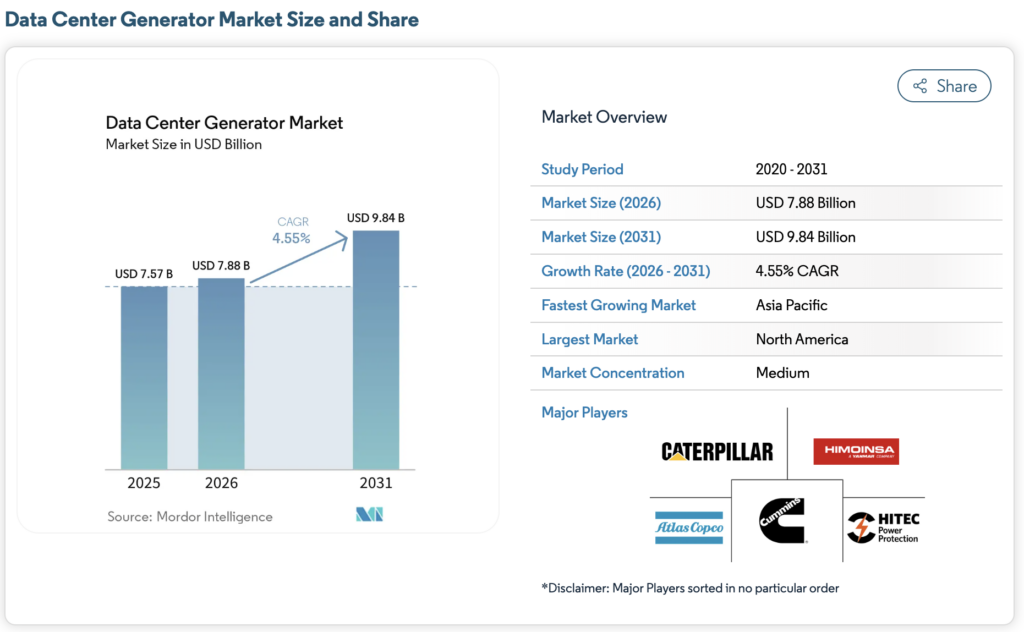
What is clear is that the need is not just for backup power, but for large, redundant and highly engineered systems. Diesel remains central to that equation: according to Mordor Intelligence, diesel gensets accounted for 81.24% of the market in 2025, while MarketsandMarkets estimates diesel generators at USD 5.79 billion in 2026.
That does not mean data centers are bigger than construction equipment. Heavy construction equipment remains a much larger market in absolute terms, but one that is more cyclical, more fragmented and increasingly shaped by electrification and emissions rules.
The opportunity in data centers is different. It is smaller, but more concentrated. A single hyperscale site can require very large standby capacity, long-term service support and a level of engineering that looks closer to critical infrastructure than traditional machine sales. Caterpillar, for example, cites a CloudHQ site in Ashburn, Virginia, where 101 Cat C175 gensets provide 313 MW of standby power.
For Caterpillar, Cummins and other power-system manufacturers, the customer is not simply buying an engine. It is buying response time, redundancy, fuel strategy, noise control, switchgear integration, remote monitoring and lifetime support. Caterpillar’s data center offering includes quick-start diesel generators, energy storage, natural gas and hydrogen-fueled generation, while highlighting transient response, block load acceptance, noise suppression and fuel efficiency.
Cummins makes a similar case. In a technical white paper, the company argues that larger generators can reduce footprint, lower maintenance costs and improve reliability in data center installations. In one 10 MW example, a 3.5 MW generator layout required fewer sets and less land than a 2.0 MW configuration, while also lowering annual maintenance cost.
Rehlko, the former Kohler Energy business, has also moved aggressively into data-center resilience. The company says it has deployed thousands of megawatts of generator power in data centers worldwide and points to 4 MW-class products as part of its mission-critical portfolio. The rebrand followed Kohler Energy’s separation from Kohler Co. in 2024, with Kohler Power Systems and Kohler Engines folded under the new Rehlko name.
Rolls-Royce is also pushing its mtu business deeper into the data-center power market. In 2025, the company announced a $24 million investment in Mankato, Minnesota, to more than double production capacity for backup power systems used in data centers. Its portfolio now extends beyond diesel into gas systems, battery containers, microgrids and longer-term low-carbon options.
Volvo Penta is taking a complementary route, building on heavy-duty Volvo Group engine technology for backup and prime power applications. The company highlights modular power systems, parallel generator configurations and strong transient performance for data centers, while also pointing to HVO100 compatibility across Volvo Penta engines produced since 2016 as a route to lower lifecycle CO₂ emissions without changing engines or fuel infrastructure.
Perkins, long familiar to generator-set manufacturers, is also framing data centers as a core critical-power application. Yanmar is another example of how engine development is being pulled toward larger stationary power needs. In a recent technical review, the company linked rising demand for higher-output emergency generators to the growth of larger data centers, highlighting its electronically controlled 12GY175L V-type diesel engine for stationary power generation.
Doosan sits slightly differently in the picture. Rather than appearing only as a standby diesel genset player, its data-center opportunity is increasingly tied to large-scale power generation for AI campuses. Doosan Enerbility has announced contracts to supply gas turbines and generators for North American data-center-driven power projects, illustrating how the buildout is affecting not only backup power but also dedicated generation infrastructure.
John Deere Power Systems sits in the broader critical-power supply chain mainly as an engine supplier to OEMs and generator packagers, rather than as a full backup-power integrator. Its generator-drive engines are designed for standby and prime-power applications, with fast response, load recovery and emissions compliance among the requirements that matter in mission-critical installations. Deere’s wider power strategy also reflects the direction of the market: in 2026, the company unveiled JD5 and JD8 engines while highlighting a multiple-pathway approach that includes next-generation diesel, renewable-fuel compatibility and battery technology.
The bigger picture for the heavy-duty market is straightforward: the next strategic battleground for large-displacement power may increasingly sit behind the fences of data centers, where AI growth, grid constraints and uptime economics are making standby generation a more valuable industrial business.



 Copyright 2017-2025 All rights reserved.