

Four 85 EC-B cranes are giving scientists access to one of the most difficult research zones in the world: the airspace above an intact section of old-growth rainforest near Manaus.
Deep inside a protected area of the Amazon rainforest, four Liebherr tower cranes are working far from the construction sites they were built for. At the AmazonFACE research site near Manaus, Brazil, the 85 EC-B units lift scientists and delicate instruments more than 45 metres above the forest floor, placing crane technology at the centre of a major climate research programme.
The site is part of AmazonFACE, a Free-Air Carbon Dioxide Enrichment experiment designed to study how an intact section of old-growth Amazon rainforest responds to higher CO₂ levels expected in the coming decades. The programme was created by Brazil’s Ministry of Science, Technology and Innovation and is led by the National Institute for Amazonian Research (INPA) in collaboration with the University of Campinas (Unicamp). Researchers from Brazil, the UK, Germany, Austria, the Netherlands and the United States are involved through the scientific committee.
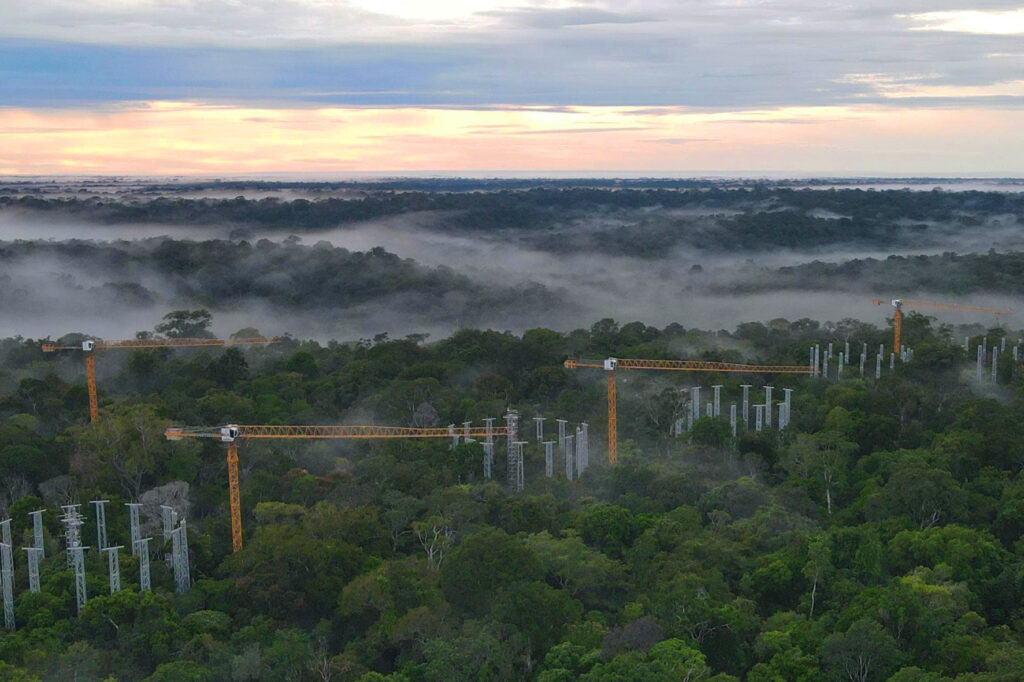
For the heavy equipment sector, the project offers an unusual case study: tower cranes being used not to assemble buildings, but to reduce disturbance in one of the planet’s most sensitive working environments. Access above the canopy is essential for measuring CO₂ concentrations, plant physiology, microclimate conditions and biodiversity indicators. In this setting, the challenge is not only height, but how to reach that height while limiting ground impact, root damage and canopy disruption.
A tower crane’s small mast footprint gives it a clear advantage over larger access structures, scaffolding systems or platforms requiring repeated relocation. Once installed, each crane can serve a wide radius across the experimental plots without continuous movement across the forest floor. For AmazonFACE, this combination of reach and limited ground occupation was central to the decision.
The four cranes lift researchers through the canopy to measurement points above the treetops, where work is carried out under the conditions created by the enriched atmosphere. The programme has obtained the required national authorisations and safety certifications for personnel lifting by tower crane.
The Liebherr 85 EC-B model was selected for its compact flat-top configuration, load stability and ability to operate in demanding climatic conditions. The flat-top design removes the traditional tower head, reducing the structure above the jib and helping multiple cranes work in overlapping radius zones. At AmazonFACE, where dense vegetation and plot coverage are key constraints, that configuration supports crane operations without the need for one unit to pass loads over another’s mast structure.
The 85 EC-B offers a maximum jib length of 50 metres and a maximum lifting capacity of 5,000 kg. Frequency-controlled drives support smooth acceleration and deceleration during hoisting and slewing, a technical detail with practical value in this application. Scientific equipment such as gas analysers, sensors and sampling tools must be moved through the canopy with limited vibration and without mechanical shock.
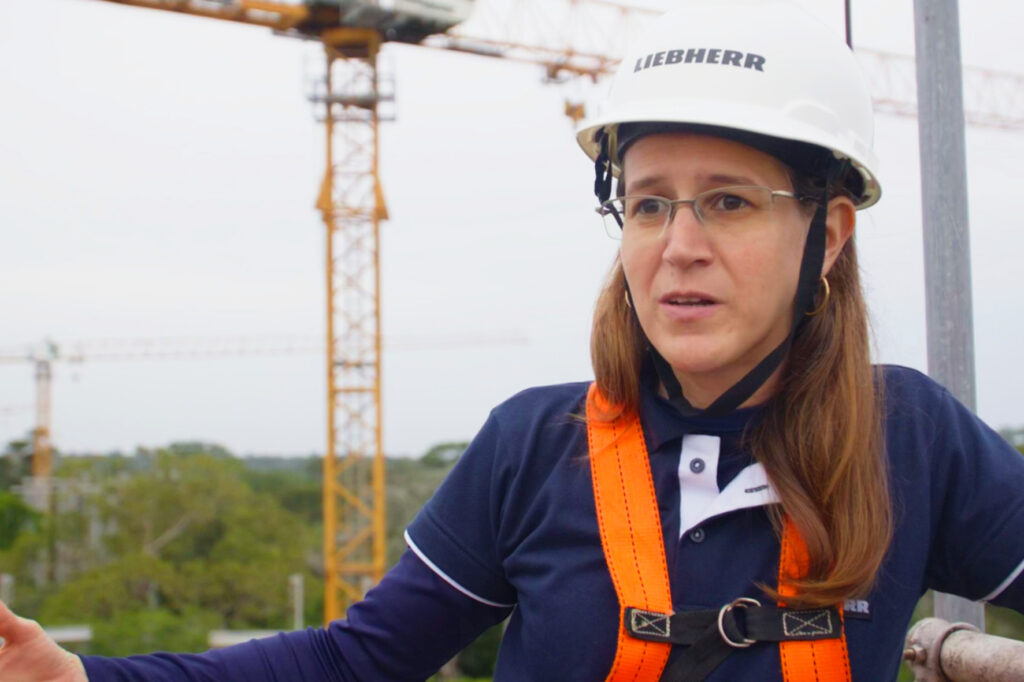
Bruna Prisco, application engineer at Liebherr in Brazil, links the crane selection to the site’s environmental and operational demands.
“Here in the Amazon rainforest, the use of the crane is that scientists can study nature conservation more efficiently. The four Liebherr 85 EC-B 5 tower cranes were chosen precisely because they can withstand the extremes of heat and humidity and not disturb the habitat,”
She said.
Two of the cranes were manufactured at Liebherr’s production facility in Brazil, while the other two were produced in Spain. Liebherr-Brasil provides operator training, maintenance instruction, spare parts supply and technical assistance for the remote research site, where continuity of support is critical to daily operations.
The scientific context is substantial. The Amazon basin stores an estimated 150 to 200 billion tonnes of carbon in vegetation and soil. How that carbon store reacts to higher atmospheric CO₂ remains a central question for climate modelling and future policy. AmazonFACE is designed to generate field data from a living ecosystem, with outputs intended to support regional Amazonian policy and international climate frameworks, including discussions linked to COP30 in Belém, Brazil, in November 2025.
Bruno Takeshi, operations lead for the AmazonFACE programme, describes the changing climate patterns already being observed in the region.
“Some phenomena that occurred very rarely began to be very frequent. The entire climate of the region started to become very abnormal,”
he said.
For site engineer Maria Juliana Monte, the work also changes the relationship between infrastructure and landscape.
“You don’t expect to be so close to the forest. And then I’m working within it – you can understand its real importance very well,”
she commented.
The cranes remain only one part of a wider scientific infrastructure, but their role is decisive. Without safe, repeatable access above the canopy, the programme could not collect data at the scale required. In the AmazonFACE project, lifting equipment becomes an enabling technology for climate science, carrying researchers and instruments into the layer of the forest where some of the most important measurements must be made.





 Copyright 2017-2025 All rights reserved.